Northwest Baltimore is one of the few places in the country where this question comes up at a counter regularly rather than in a classroom. Between Park Heights, Cheswolde, Fallstaff and the surrounding neighborhoods, plenty of households keep kosher, plenty keep halal, and the two communities live close enough together that people genuinely want to know how the rules compare. This is an honest explanation of where they overlap and where they do not. To be clear at the outset: our kitchen is halal. It is not kosher and it does not hold kosher certification.
Where the two systems agree
More than most people assume. Both are religious dietary systems rather than health codes, both forbid pork outright, and both require that permitted animals be slaughtered in a specific way by a trained person rather than killed by any method. In both traditions the animal must be healthy at the time, the knife must be sharp, and the blood must be drained rather than left in the meat. Both also treat the process as something requiring intention, not just technique. Because of that overlap, the two systems produce similar-looking outcomes on the shelf, which is why people conflate them.
Where they clearly differ
Alcohol. This is the largest practical difference and the one most often missed. Halal prohibits alcohol entirely, including as a cooking ingredient. Kosher does not, and kosher wine is its own category. In a Japanese kitchen this matters enormously, because mirin and cooking sake are standard in teriyaki and eel sauce. A sauce can be perfectly kosher and not halal.
Meat and dairy. Kosher law separates them, with waiting periods between eating one and the other and separate utensils for each. Halal has no such rule. A halal kitchen can serve a cheese-topped dish next to a meat dish without issue.
Seafood. Kosher permits only fish with fins and scales, which excludes shellfish and shrimp. Halal is broader, though opinions differ between schools of Islamic law, with some more restrictive on shellfish than others. This is one to check against your own practice rather than assume.
Certification. Kosher supervision in the United States is highly centralized, with recognized agencies and a symbol on the package. Halal certification is far less centralized, which is why halal diners tend to ask restaurants direct questions rather than look for a single symbol. That difference is structural, not a reflection of how seriously either is taken.
The question people actually ask
Whether someone keeping halal can eat kosher meat, or the reverse, is a matter of religious opinion rather than fact, and the answer varies by tradition and by scholar. Some Muslims accept kosher meat where halal is unavailable, on the reasoning that the slaughter requirements are close. Others do not. Those keeping kosher generally do not treat halal meat as kosher, because kosher certification requires supervision that halal certification does not provide. The honest answer is that this is a question for your own religious authority, not for a restaurant blog. What a restaurant can usefully do is tell you exactly what is in the food and how it was handled, and let you decide.
What our kitchen is, precisely
We are halal. The full menu is halal, there is no pork served, stored or cooked anywhere in the building, and our sauces are made in house rather than bought from a distributor, which is why we can answer ingredient questions rather than guess at them.
We are not kosher and we do not hold kosher certification. There is no rabbinical supervision on the premises and we do not separate meat and dairy. Anyone keeping kosher should not treat this kitchen as an option, and we would rather say that plainly than be vague about it. If you keep halal, this is a kitchen where you do not have to ask questions item by item. If you keep kosher, it is not, and it would be dishonest to blur that.
Eating in Northwest Baltimore either way
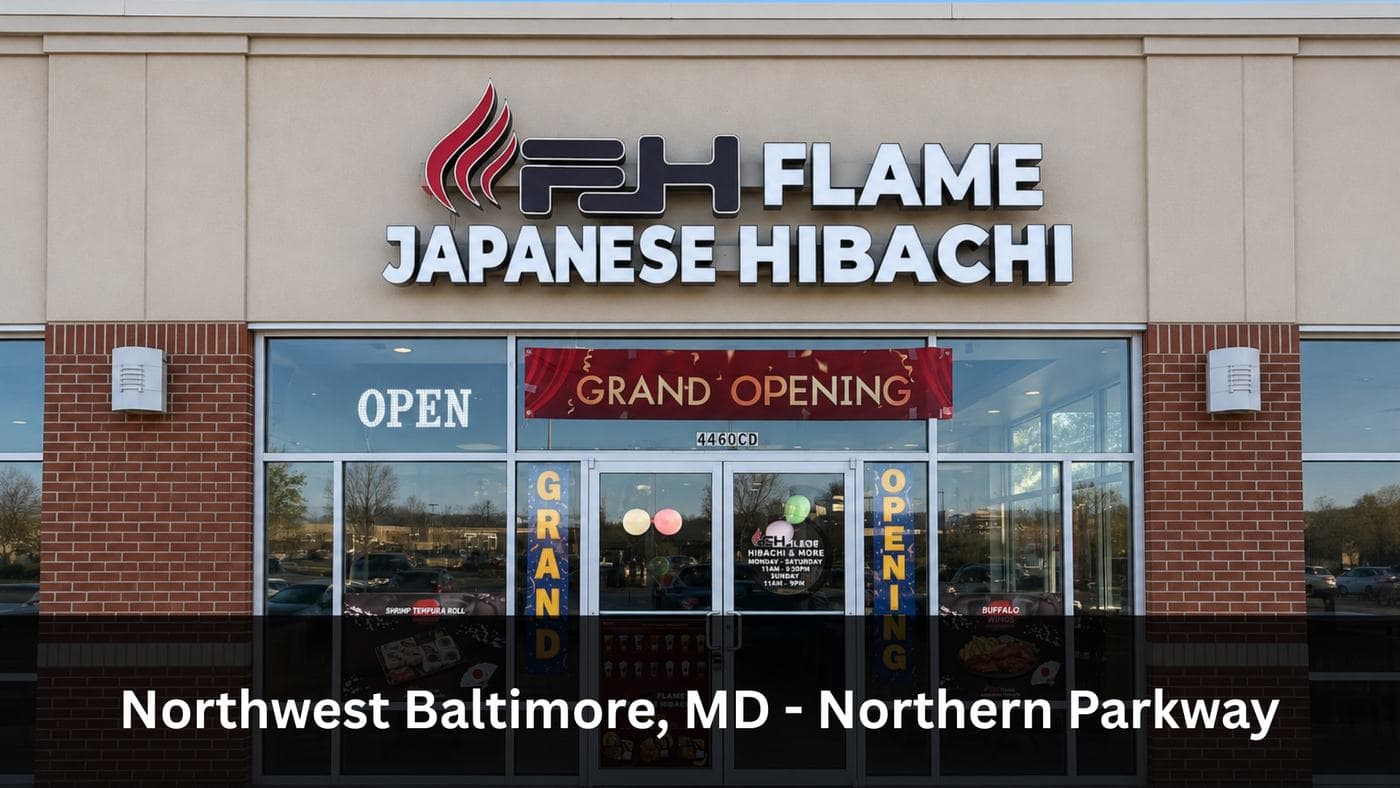
We are at 4460 W Northern Parkway, close to Park Heights, Cheswolde, Fallstaff, Mount Washington and Cross Country, and about ten minutes from Pikesville out Reisterstown Road.
Visit us
A halal kitchen in Northwest Baltimore, with straight answers about what is in the food. Flame Japanese Hibachi Northern Parkway, 4460 W Northern Parkway, Baltimore, MD 21215. 410-801-8279.