Sushi is one of the more confusing foods to evaluate for halal status, because the question is not really about the fish. It is about several separate ingredients most people never think to check, several of which have nothing to do with whether the seafood itself is permitted. This is a component-by-component explanation, written from our kitchen at Seven Corners, and it applies to any sushi counter you visit, not just ours.
The fish itself is usually the easy part
Most fish and seafood used in standard sushi rolls, salmon, tuna, crab, shrimp, are broadly considered permissible across the majority of Islamic legal opinion, though views differ between schools of thought, particularly on shellfish specifically. If shellfish is a question for your own practice, that is worth checking against your own religious authority rather than assuming either way.
Fish generally does not require the ritual slaughter that land animals do, which is part of why sushi is often assumed to be automatically halal. That assumption is where the real problems start.
Where sushi actually goes wrong
Alcohol in the rice. Traditional sushi rice is seasoned with rice vinegar, sugar and salt, and that part is fine. The complication is that some sushi rice recipes and some pre-made sushi vinegar blends include mirin, which is alcohol. This varies by kitchen and is not something you can see or taste reliably.
Alcohol in the sauces. This is the biggest and most commonly missed issue. Eel sauce, often used on rolls with cooked eel or as a drizzle, is traditionally made with mirin and sake. Spicy mayo and other modern sauce additions are usually fine, but traditional eel sauce specifically is a real concern.
Imitation crab. A huge share of American sushi rolls, including the California Roll, use imitation crab rather than real crab meat. Imitation crab is a processed fish product, typically pollock, and it can contain wine or mirin as a flavoring agent depending on the manufacturer. This is worth asking about specifically, because most people assume imitation crab is automatically simple and it is not.
Shared preparation surfaces. If a kitchen prepares sushi and also cooks pork elsewhere, cross-contact on shared cutting boards, knives or prep stations is a real concern, separate from the ingredients in the roll itself.
Cooking wine in tempura batter or fillings. Some tempura batters and some cooked fillings use sake or mirin as part of the recipe.
The questions worth asking at any sushi counter
Five, and they cover almost everything above.
Does the sushi rice contain mirin. Does the eel sauce, if used, contain mirin or sake. What brand or recipe is the imitation crab, and does it contain alcohol. Is there any pork prepared in the same kitchen, and if so, on shared surfaces. Is any tempura batter made with cooking wine.
A kitchen that has thought about halal sushi specifically will have real answers to all five. A kitchen that has not will generally default to "the fish is halal" and stop there, which is not actually the full question.
What our kitchen does
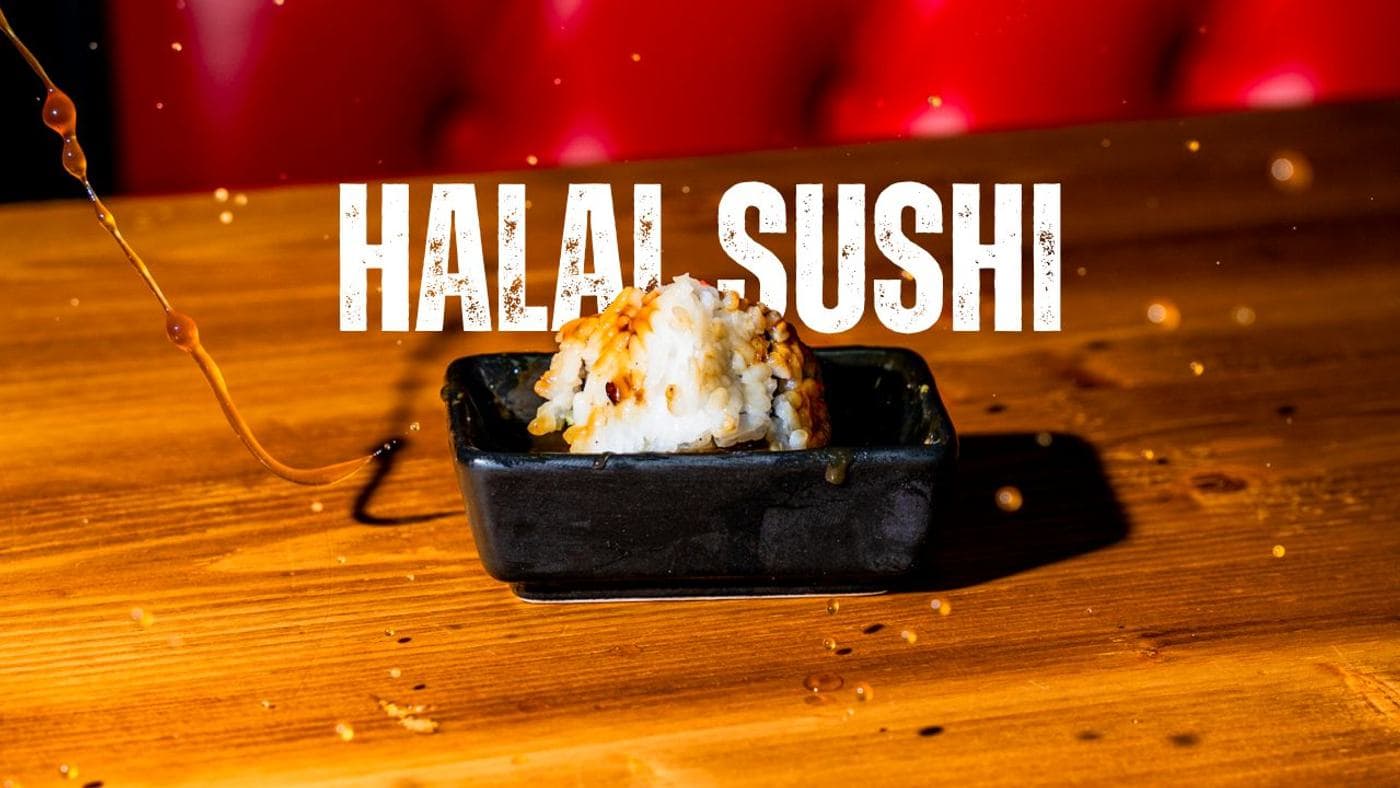
The entire menu here is halal, including every sushi roll, with no pork served, stored or cooked anywhere in the building, which removes the cross-contact question entirely. Our sauces, including anything used on or with sushi, are made in house rather than bought from a distributor, which is what allows us to control for mirin and cooking sake rather than trusting a label.
Rolls with nothing raw, if that is also a concern
Separate from the halal question, several of our rolls contain no raw fish at all: the California Roll, Shrimp Tempura Roll, Hibachi Chicken Roll, Avocado Roll, Avocado and Cucumber Roll, and Spicy Crab and Shrimp Roll, all $7.85 to $9.85. If raw fish is also something you avoid, that is a separate filter worth applying alongside the halal question.
At our Seven Corners location
We are at 6379 Seven Corners Center, Falls Church, VA 22044, inside the Seven Corners shopping center at the Route 7 and Route 50 junction.
Halal sushi questions
Is sushi automatically halal? No. The fish itself is usually fine, but sushi rice, eel sauce, imitation crab and tempura batter can all contain alcohol depending on the kitchen.
What is the biggest hidden issue in halal sushi? Eel sauce and sushi rice seasoning, both of which can traditionally include mirin, a rice wine.
Is imitation crab halal? It depends on the manufacturer. Some formulations include wine or mirin as flavoring, so it is worth asking rather than assuming.
Is your sushi halal? Yes. The full menu is halal, sauces are made in house, and no pork is served, stored or cooked anywhere in the building.
Do you have sushi with no raw fish? Yes, several rolls including the California Roll and Shrimp Tempura Roll contain nothing raw.
Is shellfish considered halal? Views differ between schools of Islamic thought. This is worth checking against your own religious practice.
Visit us
Flame Japanese Hibachi Seven Corners, 6379 Seven Corners Center, Falls Church, VA 22044. 571-480-5161.